



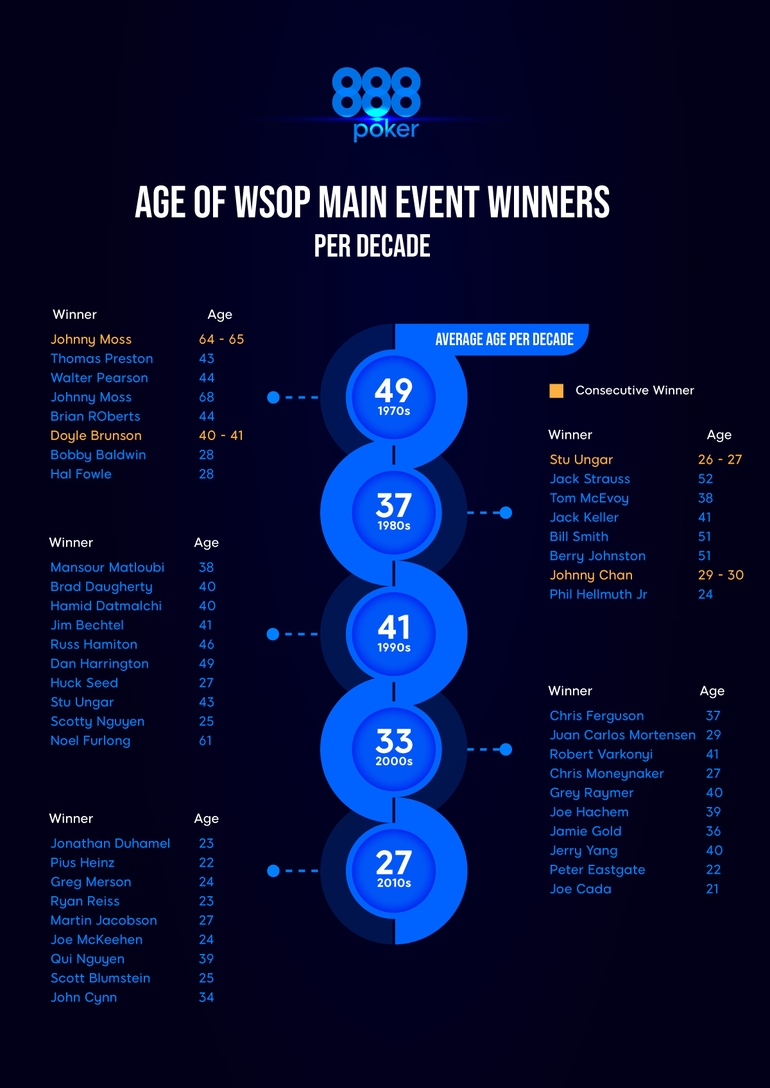
Age matters in the WSOP Main Event, but it does not decide who wins. Younger players often benefit from online experience, study volume and faster adaptation, while older players bring patience, discipline and live poker experience.
The real advantage comes from combining both sides: modern strategy, strong preparation, mental endurance and the ability to stay focused through one of poker’s longest and most demanding tournaments.
Key takeaways: age and the WSOP Main Event
- Younger players have become more common at WSOP Main Event final tables.
- The online poker boom helped young players gain experience faster.
- Older players still benefit from patience, discipline and emotional control.
- The November Nine era gave prepared players more time to study.
- The strongest Main Event players combine preparation, stamina and live experience.
How age trends changed in the WSOP Main Event
In the early years of the WSOP Main Event, final tables were generally older and much smaller. The event attracted fewer players, and most competitors built their experience slowly in live poker rooms.
As the Main Event grew, the age profile began to change. The poker boom, online satellites and improved access to strategy content brought a younger generation into major poker tournaments.
The Moneymaker effect and the rise of younger players
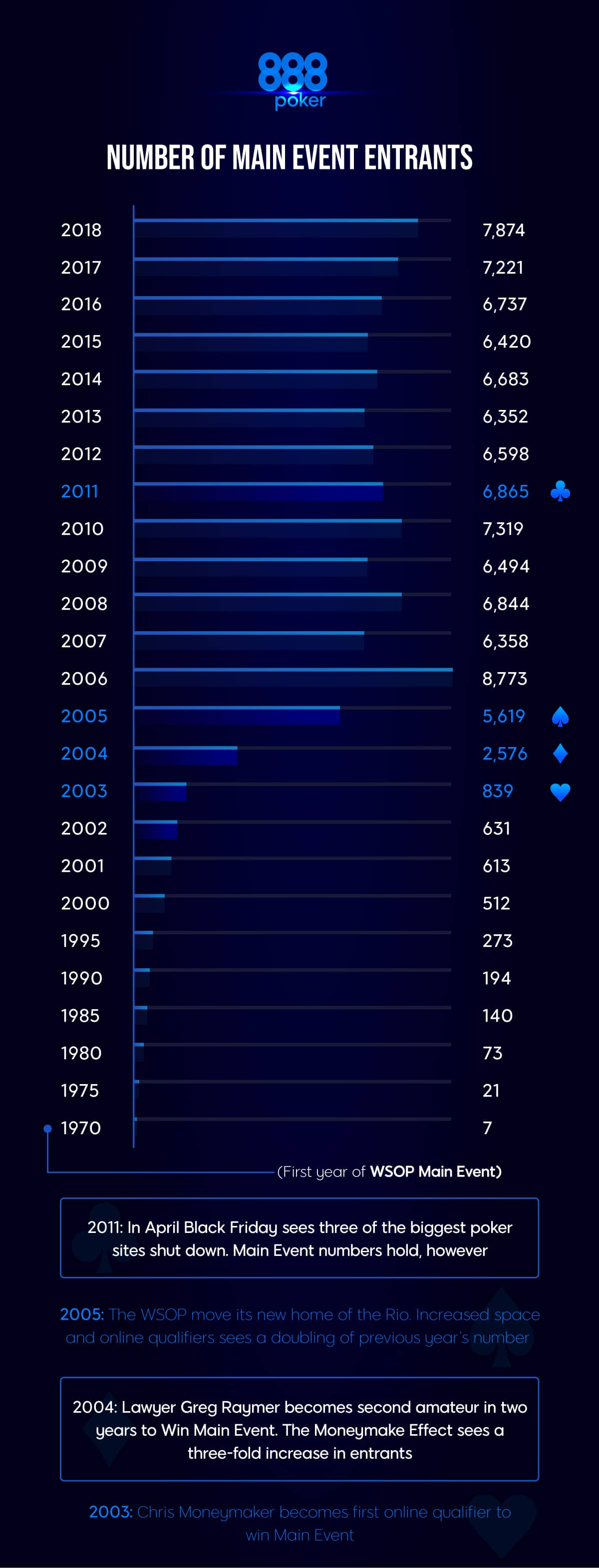
Chris Moneymaker’s 2003 WSOP Main Event win changed poker history. As an online qualifier, he showed that players outside the traditional live poker world could compete for the biggest title in the game.
His victory inspired a new generation of players to enter the WSOP through online satellites, study harder and take poker more seriously as a skill-based competition.
This shift helped younger players gain experience faster than previous generations. Instead of waiting years to build live experience, they could play thousands of hands online before reaching major live events.
Why younger players became more successful
Younger players gained an edge because online poker allowed them to develop skills at a much faster pace. They could play more hands, review more decisions and improve more quickly than players from earlier live-only eras.
- More hands played online
- Better access to study tools and strategy content
- More comfort with aggressive tournament play
- Greater exposure to online satellites and qualifiers
- More time to focus heavily on poker
Many younger players also entered poker through digital environments, making the transition to fast decision-making and high-volume study feel more natural.
The role of online satellites and buy-ins
Online satellites helped change who could access the WSOP Main Event. Players no longer needed to build a bankroll only through live casinos; they could qualify online and reach the biggest stage in poker.
This mattered especially for younger players, who were often more comfortable playing online and using digital platforms to build experience.
Buy-ins, staking and wider tournament access also made it easier for strong younger players to enter major events. As poker grew globally, more players had a realistic path to the Main Event.
Did the November Nine help younger players?
The November Nine format began in 2008 and paused the WSOP Main Event after the final table was set. The final nine players returned months later to play for the title.
This break gave players time to study opponents, review hands, work with coaches and prepare for final-table pressure. For younger players already used to structured poker study, this may have created an advantage.
Still, the November Nine was not the only reason younger players performed well. The bigger shift came from the online poker boom and the rise of better training methods.
What young players bring to the WSOP Main Event
Younger players often bring technical confidence, study discipline and high-volume experience. Many are used to analysing hands, discussing strategy and adapting quickly to new poker trends.
- Modern poker theory
- Online tournament experience
- Comfort with aggression
- Faster adaptation
- More structured study habits
They may also have fewer outside distractions, allowing them to focus more fully on preparation before and during the tournament.
What older players bring to the WSOP Main Event
Older players may not always have the same online hand volume, but they often bring qualities that matter deeply in a long live tournament.
- Patience during long card-dead stretches
- Experience reading live table dynamics
- Emotional control after big pots
- Better risk management
- More maturity in high-pressure spots
The WSOP Main Event is not only a technical poker test. It is also a mental endurance challenge, where emotional stability can be just as important as theory.
Experience still matters
For a while, it looked as if very young online players might dominate the Main Event permanently. But recent trends suggest that experience still matters.
Players often perform best when they have both online and live tournament experience. Online poker can build technical skill, but live poker requires patience, table awareness and comfort with long days.

The strongest modern players are rarely just online specialists. They usually have a mix of study experience, live results, discipline and tournament endurance.
Why stamina and preparation matter
The WSOP Main Event can last many long days, with players needing to stay focused through deep stacks, pressure spots and constant decision-making.
Stamina matters for every age group. Younger players may have more physical energy, but older players can compensate through preparation, pacing and emotional control.
Good preparation includes sleep, nutrition, focus, bankroll planning and mental discipline. These factors often matter more than age alone.
Mindset may matter more than age
The biggest factor in the WSOP Main Event is not age alone, but mindset. Players must recover from bad beats, avoid emotional decisions and stay sharp for long sessions.
Younger players may learn faster, but older players may handle pressure better. The ideal player combines technical study with patience, maturity and focus.
Can older players still succeed?
Yes. Older players can still make deep WSOP Main Event runs when they prepare well and use their strengths. Players such as Neil Blumenfield and Pierre Neuville showed that age does not prevent success at the highest level.
Their deep runs highlight the value of patience, live experience and mental strength in a long tournament format.

The future of age in the WSOP Main Event
The future WSOP Main Event champion is unlikely to be defined by age alone. The strongest profile is probably a player with modern study habits, proven live experience, strong mental preparation and the stamina to survive long tournament days.
Young players will continue to be dangerous because of their technical skill and study volume. Older players will remain competitive when they adapt, prepare and use their live experience effectively.

So, does age matter in the WSOP Main Event?
Age matters, but it is only one part of the WSOP Main Event story. Younger players often have advantages in study volume, online experience and technical development. Older players often bring patience, discipline and emotional control.
The best Main Event players are those who prepare properly, adapt to modern poker and stay mentally sharp under pressure. In the end, age can influence performance, but it does not decide the winner.
FAQ about age in the WSOP Main Event
Does age matter in the WSOP Main Event?
Yes, age can matter, but it is not the deciding factor. Preparation, mindset, experience and adaptability usually matter more than age alone.
Why do younger players often perform well in the WSOP Main Event?
Younger players often perform well because online poker allows them to play more hands, study more efficiently and gain experience faster than previous generations.
Can older players still win the WSOP Main Event?
Yes. Older players can still succeed if they prepare well and use their strengths in patience, live experience and emotional control.
Did the November Nine help younger players?
The November Nine may have helped younger players because it gave them time to study and prepare. However, the online poker boom was likely a bigger factor in the rise of young champions.
What age is best for poker success?
There is no single best age for poker success. Many strong players combine the energy and study habits of younger players with the patience and discipline of experienced players.
What matters more than age in poker?
Mindset, preparation, discipline, patience and adaptability are more important than age, especially in long tournaments like the WSOP Main Event.
