

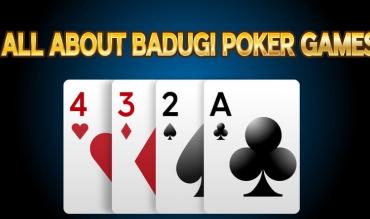

Badugi is a draw poker variant where the goal is to make the lowest possible four-card hand, with each card of a different suit. It belongs to the lowball family of poker games, but its unique hand-ranking system puts it in a category of its own.
Badugi Hand Rankings
What is a Badugi in poker?
A Badugi is a four-card hand made up of cards with four different ranks and four different suits. Aces are low, so the best possible Badugi is A-2-3-4 of four different suits, called a "four-high Badugi". The lower the highest card, the stronger the hand.
How are Badugi hands ranked?
Suited cards and paired cards both work against you. If two cards share a suit or a rank, the higher of the two doesn't count, which reduces your hand from four cards to three (or fewer). The number of cards in a valid hand always takes priority over card ranks – a four-card Badugi of any rank beats a three-card Badugi of any rank.
These four examples cover the key scenarios a new player will encounter:
- 8♥️ 7♣️ 6♠️ 4♦️ – A four-card Eight-high Badugi. All four cards are of different suits and different ranks, so the full hand counts. This is a strong hand.
- K♥️ 7♣️ 3♠️ 2♦️ – A four-card King-high Badugi. Valid, but weaker than the example above: the highest card determines strength when both hands have four cards.
- T♥️ 7♠️ 5♣️ 2♣️ – Not a four-card Badugi. The Five of clubs and the Deuce of clubs share a suit. Only the lower card (2♣️) counts, leaving a three-card Ten-high Badugi (T♥️, 7♠️, 2♣️). This hand loses to both examples above despite containing low cards. This is the most common mistake beginners make: assuming low cards guarantee a strong hand.
- 4♦️ 4♥️ 2♣️ 2♠️ – A two-card Badugi. Both pairs share either rank or suit with another card, leaving only two valid cards. Despite the low ranks, this hand is near-worthless in a contested pot.
How a Hand of Badugi Works
How does a hand of Badugi play out?
Each player is dealt four private cards. A hand consists of four betting rounds separated by three drawing rounds. At each draw, players may discard any number of cards (including all four) and receive replacements from the deck. A player who keeps all four cards is said to stand pat.
Blinds
The small blind and big blind are posted before any cards are dealt, by the two players immediately left of the dealer button – the same structure as Texas Hold'em and Omaha.
Pre-draw
Each player receives four face-down cards. Betting begins with the player left of the big blind and moves clockwise. The big blind acts last.
Draws and post-draw betting
After each of the first three betting rounds, players draw starting from the small blind and moving clockwise. Each player announces how many cards they're discarding and draws the same number from the deck. If the deck runs out, the discard pile is reshuffled and used as a fresh deck.
The complete structure of a hand:
- Blinds posted
- Deal – four cards each
- Pre-draw betting round
- Draw 1
- Betting round
- Draw 2
- Betting round
- Draw 3
- Final betting round
- Showdown
Showdown
After the final betting round, players reveal their hands. The pot goes to the player holding the best Badugi – the lowest-ranked, most complete hand by card count.
Betting Actions in Badugi
What are the betting options in Badugi?
Badugi uses the same six betting actions as most poker variants:
- Check – Pass the action to the next player without wagering. Only available when no bet has been made in the current round.
- Bet – Make the first wager of the round. All remaining players must call, raise, or fold.
- Call – Match the current bet exactly to remain in the hand.
- Raise – Increase the size of the current bet. The original bettor must at least match the raise or fold.
- Re-raise – Raise again after a raise has already been made on the same street.
- Fold – Discard your hand and forfeit all claim to the pot.
Key Strategy: When to Draw and When to Stand Pat
Standing pat doesn't always mean staying pat. If you hold a four-card King-high Badugi and your opponent is still drawing, standing pat is often correct – statistically, a player drawing one card is unlikely to complete a four-card Badugi on any given street.
However, if your opponent stands pat early, they probably hold a Badugi stronger than King-high. In that case, breaking your hand and drawing again can be correct, even if you've been standing pat on earlier streets. The decision is based on your read of the opponent, not on what you did the previous street.
Badugi FAQ
What beats what in Badugi?
Hand size always comes first. Any four-card Badugi beats any three-card Badugi, and any three-card Badugi beats any two-card Badugi. Within the same card count, the hand with the lowest highest card wins. If the highest cards tie, compare the second-highest, and so on.
Can you play Badugi with fewer than four cards?
Yes. If suited or paired cards reduce your valid hand below four cards, you still play – you simply have a weaker hand. A two-card or three-card Badugi can still win if all opponents are in the same position or worse.
What does standing pat mean in Badugi?
Standing pat means drawing zero cards at a draw stage. It signals to opponents that you're satisfied with your current hand, which is usually interpreted as holding a strong Badugi.
How many players can play Badugi?
Badugi is typically played with two to eight players. With eight players and multiple draws, the discard pile may need to be reshuffled mid-hand.
Is Badugi a fixed-limit or no-limit game?
Badugi is most commonly played in a fixed-limit format, where bet sizes are set in advance for each street. Pot-limit and no-limit versions exist but are less common.
Badugi: Key Rules at a Glance
- The goal is the lowest four-card hand with each card of a different suit.
- Aces are low. The best hand is A-2-3-4 of four different suits.
- Suited or paired cards don't count – they reduce your hand size.
- A four-card Badugi always beats a three-card Badugi, regardless of rank.
- There are four betting rounds and three drawing rounds per hand.
- Players may draw between zero and four cards at each draw. Drawing zero is standing pat.
- Pre-draw betting starts left of the big blind. Post-draw betting starts left of the button.
- At showdown, the pot goes to the player with the most complete, lowest Badugi.
