



In PLO (Pot Limit Omaha), straight draws with more than eight outs are called wraps. They range from 13 outs up to a maximum of 20, and counting them accurately while assessing their quality is one of the most important skills in the game.
This guide covers the most common PLO wrap scenarios, from the 13-out nut wrap to 20-out monster draws and combo draws combining straights with flush draws.
What Is a Wrap in PLO?
The term "wrap" comes from the way hole cards wrap around the board cards to form a straight draw. Because PLO players hold four preflop cards rather than two, more hole cards can connect with the board, producing straight draws that go well beyond the eight outs available in Texas Hold'em.
The number of outs in a wrap depends on three factors:
- How many hole cards connect consecutively with the board
- Whether those cards sit above, below, or around the board cards
- Which cards you already hold (blocking your own outs)
Counting outs is only half the job. A wrap with fewer outs can be more valuable than one with more outs if those outs make the nut straight rather than a dominated one.
The 13-Out Nut Wrap
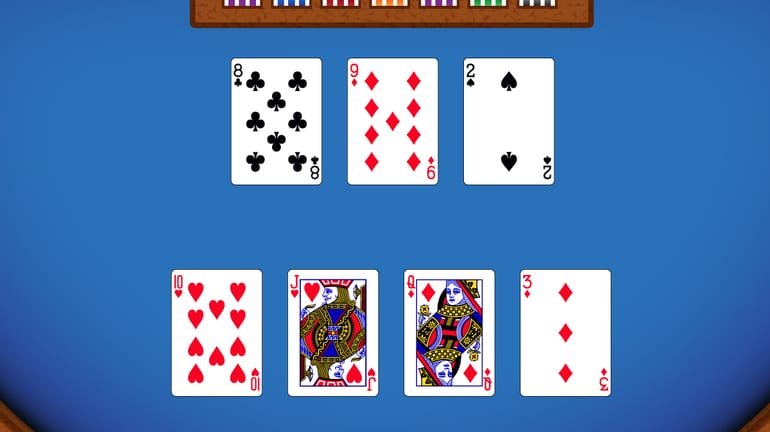
Board: 8♣️9♦️2♠️
Hand: T♥️J♥️Q♦️3♦️
Three consecutive hole cards sitting directly above the top board card produce a 13-out nut wrap. Any Seven, Ten, Jack, or Queen completes the nut straight.
- Seven: 4 outs (none in hand)
- Ten: 3 outs (one in hand)
- Jack: 3 outs (one in hand)
- Queen: 3 outs (one in hand)
Total: 13 outs – all nutted
Cards held in hand block one out each (4 becomes 3); the Seven below the board stays fully available. Three consecutive cards above the board always produces 13 nutted outs.
The 13-Out Non-Nut Wrap
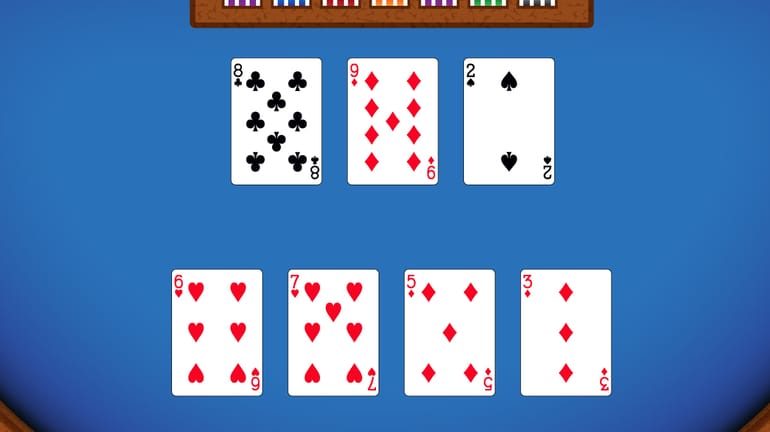
Board: 8♣️9♦️2♠️
Hand: 6♥️7♥️5♦️3♦️
Three consecutive hole cards sitting below the board also produce 13 outs – but most are non-nut. Any Ten, Five, Six, or Seven completes a straight, but because our cards sit below the board, most of those straights can be beaten.
- Five: 3 outs (one in hand)
- Six: 3 outs (one in hand)
- Seven: 3 outs (one in hand)
- Ten: 4 outs (none in hand)
Total: 13 outs – mostly non-nut
Same count as the nut wrap above, very different quality. Position relative to the board determines nut quality, not just out count. And in a large pot, non-nut outs can be a liability.
The 16-Out Nut Wrap
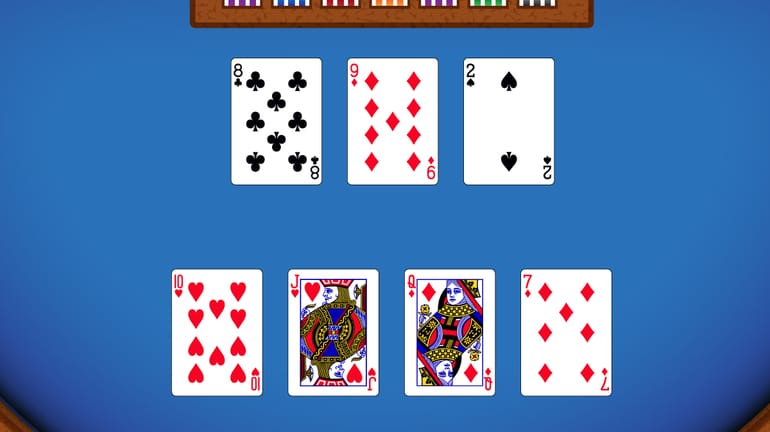
Board: 8♣️9♦️2♠️
Hand: T♥️J♥️Q♦️7♦️
When all four hole cards connect with the board, the out count rises to 16. The Seven opens an additional straight combination: a Six on the turn gives us the Ten-high nut straight using T7.
- Six: 4 outs (none in hand)
- Seven: 3 outs (one in hand)
- Ten: 3 outs (one in hand)
- Jack: 3 outs (one in hand)
- Queen: 3 outs (one in hand)
Total: 16 outs – all nutted
Pattern: four consecutive hole cards wrapping around both sides of the board, with the board cards in the middle of the run.
The 17-Out Non-Nut Wrap
Board: 8♣️9♦️2♠️
Hand: T♥️J♥️3♦️7♦️
Using only three hole cards, we gain one extra out compared to the 16-out nut wrap – but lose the nut on one of them. Without the Queen in hand, we don't block that out (4 remain instead of 3). However, a Ten on the turn gives us J7 for the non-nut straight – TJ would be the nuts.
- Six: 4 outs (none in hand)
- Seven: 3 outs (one in hand)
- Ten: 3 outs (one in hand)
- Jack: 3 outs (one in hand)
- Queen: 4 outs (none in hand)
Total: 17 outs – three non-nut
The direct trade-off: holding the Queen means 16 fully nutted outs; not holding it means 17 outs with three non-nut. Neither is universally better – pot size, opponent range, and board texture all factor in.
The 20-Out Wrap
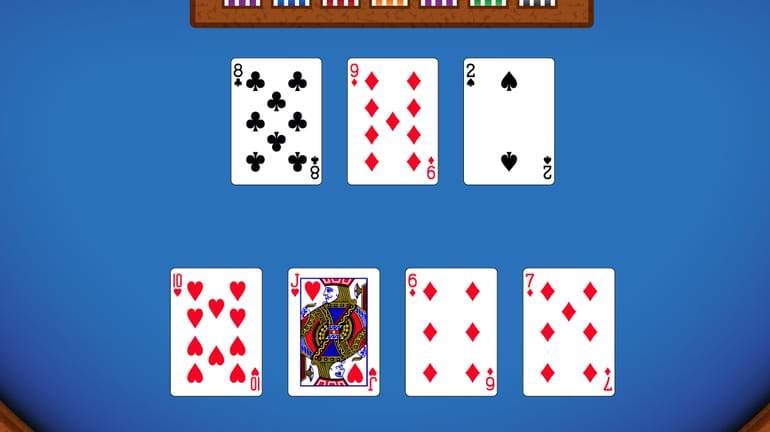
Board: 8♣️9♦️2♠️
Hand: T♥️J♥️6♦️7♦️
The maximum possible straight draw in PLO has 20 outs. It requires a double-gap in the hand – here, between the 7 and the T, and between the J and the next board card. Never fully nutted, but enormous equity against most hands.
- Five: 4 outs (none in hand)
- Six: 3 outs (one in hand)
- Seven: 3 outs (one in hand)
- Ten: 3 outs (one in hand)
- Jack: 3 outs (one in hand)
- Queen: 4 outs (none in hand)
Total: 20 outs – partially non-nut
Pattern: a double-gap hand straddling both sides of the board. Always partially non-nut; always the maximum possible 20.
Combo Draws: Wraps Combined With Flush Draws
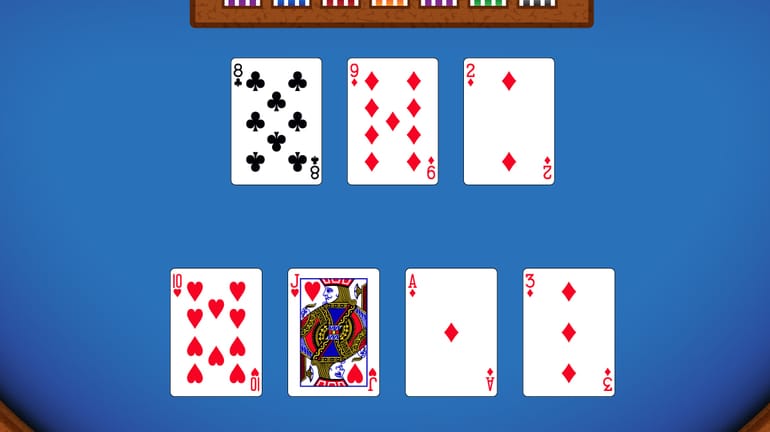
Board: 8♣️9♦️2♦️
Hand: T♥️J♥️A♦️3♦️
In PLO, wraps frequently combine with flush draws to create combo draws with substantial equity. The key rule when counting: never double-count outs that complete both the straight and the flush.
This hand has an open-ended straight draw (eight outs) alongside a flush draw (nine outs). Two of those straight outs are diamonds, so they're already counted in the flush outs. We take six straight outs and add nine flush outs.
- Non-diamond Queens: 3 outs
- Non-diamond Sevens: 3 outs
- Diamonds: 9 outs
Total: 15 outs
Blocker effects apply here too: holding the J♦️ instead of the J♥️ blocks one flush out, reducing the total to 14. Unlike Hold'em, PLO combo draw outs are never fully static – your exact cards determine the count.
PLO Outs Quick Reference
- A wrap is any PLO straight draw with more than eight outs. Wraps range from 13 to 20 outs.
- Three consecutive cards above the board = 13-out nut wrap.
- Three consecutive cards below the board = 13-out non-nut wrap.
- Four cards wrapping around the board = 16-out nut wrap.
- A double-gap hand straddling the board = 20-out wrap (maximum possible, never fully nutted).
- Holding a card reduces its available outs from 4 to 3. Not holding it keeps 4 outs but may cost the nut.
- In combo draws, never double-count outs that complete both the straight and the flush.
- PLO combo draw outs are hand-specific. Blocker effects mean the same draw type can have different out counts in different hands.
- Out quality matters as much as out count. 13 nutted outs can be more valuable than 17 dominated outs in a large pot.
