



The Chen Formula is a mathematical system for assigning a point score to starting hands in Hold'em. Developed by Bill Chen, it was designed to help players make consistent preflop decisions in No-Limit Hold'em by reducing hand selection to a simple calculation.
In the modern game, the formula is rarely used by professionals. It's better understood as a learning tool than a playing system – useful for beginners building intuition about hand strength, less useful once a player starts thinking in ranges and equity.
How the Chen Formula Works
The formula assigns a point score to any two-card starting hand using four steps. Apply them in order.
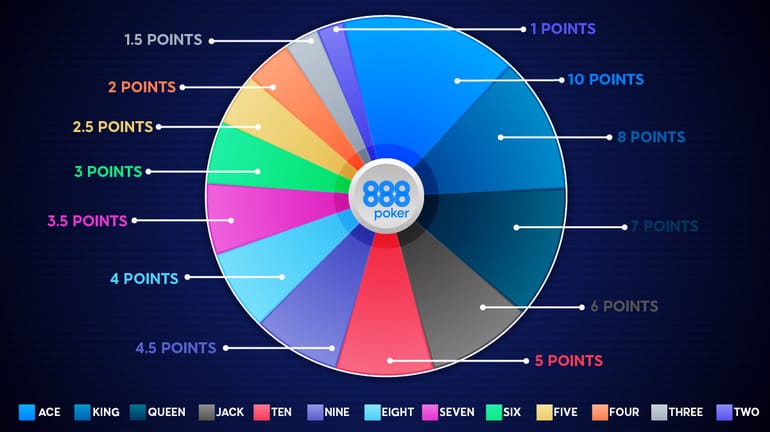
Step 1 – Score the high card
- Ace = 10 points
- King = 8 points
- Queen = 7 points
- Jack = 6 points
- Ten through Deuce = half the card's face value (e.g. a Seven = 3.5 points)
Step 2 – Apply the pocket pair rule
If both cards are the same rank, multiply the high card score by 2. The minimum score for any pocket pair is 5 points. So pocket threes (1.5 × 2 = 3) are rounded up to 5.
Step 3 – Apply the gap penalty
Subtract points based on the gap between your two cards:
- Connected (no gap) – subtract 0
- 1-gapper – subtract 1
- 2-gapper – subtract 2
- 3-gapper – subtract 4
- 4-gapper or more – subtract 5
Note: the Ace is always treated as high. A2 is a 4-gapper, not a connected hand.
Step 4 – Apply bonuses and round up
- Suited hands: add 2 points
- Connected or 1-gap hands where the high card is Queen or lower: add 1 point
- Any half-point score (e.g. 7.5): round up to the next whole number
Chen Formula – Worked Examples
AA: Ace = 10 points. Pocket pair rule: 10 × 2 = 20 points.
AKo: Ace = 10 points. King is directly connected to the Ace, so no gap penalty. No suited bonus. Total = 10 points.
JTs: Jack = 6 points. Suited bonus: +2. Connected, high card below Queen: +1. Total = 9 points.
A5o: Ace = 10 points. 4-gap penalty: −5. Total = 5 points.
72o: Seven = 3.5 points. 4-gap penalty: −5. Score = −1.5, rounded up to −1 point.
33: Three = 1.5 points. Pocket pair rule: 1.5 × 2 = 3. Below the 5-point minimum, so total = 5 points.
Limitations of the Chen Formula
The formula's core limitation is that it treats preflop hand strength as absolute. In practice, no ranking system can do that accurately – poker hands don't have a fixed hierarchy because of the "rock, paper, scissors" effect.
Consider these three preflop equity matchups:
- AKo vs 55: 55 wins with 54.6% equity
- T9s vs 55: T9s wins with 52.3% equity
- AKo vs T9s: AKo wins with 59.5% equity
Each hand beats one of the others. No linear score can capture that. The Chen Formula ranks AKo at 10 points, T9s at 8, and 55 at 5 – but all three can be the strongest hand depending on the opponent's range.
This isn't a flaw in the formula specifically. It reflects the fundamental complexity of poker. No preflop scoring system can fully solve it.
Other Variables the Formula Ignores
Stack depth. As effective stacks grow deeper, the value of suited Aces, mid-to-high pocket pairs, and suited connectors increases relative to off-suit broadways and weaker pairs. The threat of reverse implied odds in dominated situations makes hands like A5s situationally stronger than AKo at very deep stacks. The Chen Formula assigns the same score regardless of depth.
Multiway action. Suited and connected hands gain significant value in multiway pots. Off-suit, non-connected hands (including high-equity holdings like AJo) lose value. A point-score system built around heads-up equity doesn't account for this shift.
Opponent type. Against calling stations, raw equity and showdown value matter most. Against frequent folders, more speculative hands that can hit strong made hands by the river become preferable. The formula can't adjust for this.
Betting structure. The Chen Formula was developed during an era when fixed-limit poker was common. In fixed-limit games, raw equity matters more; in no-limit games, the ability to make strong 5-card holdings is more important. The same point values don't translate cleanly between formats.
Should You Use the Chen Formula?
The Chen Formula is a reasonable starting point for beginners learning which hands have baseline value in Texas Hold'em. It provides a quick, consistent framework for preflop hand selection before a player has developed range-based thinking.
For experienced players, it adds little. The variables it ignores, like stack depth, opponent tendencies, table dynamics, multiway action, etc. are precisely the factors that define correct preflop decisions at higher levels of play.
Think of it as training wheels: useful early on, but something most players outgrow as they develop a more complete understanding of the game.
Key Takeaways
- The Chen Formula scores Hold'em starting hands using high card value, gap penalties, suit bonuses, and a pocket pair multiplier.
- Pocket pairs always score a minimum of 5 points; any half-point total is rounded up.
- The Ace is always treated as high – A2 is a 4-gapper, not a connected hand.
- The formula cannot account for stack depth, opponent type, multiway dynamics, or betting structure.
- No preflop ranking system can be fully accurate due to the non-linear equity relationships between hands.
- The Chen Formula is best used as a learning tool for beginners, not as a playing system for experienced players.
