



A poker leak is a repeatable strategic mistake that costs money over time. Most small and medium stakes players have multiple leaks – patterns in their betting, hand selection, or aggression that attentive opponents can identify and exploit consistently.
The most common poker mistakes at small and medium stakes are:
- Playing too straightforwardly – bet sizing telegraphs hand strength
- Playing too trickily – deceptive patterns become equally readable
- Telegraphing specific hands with unique bet sizes
- Raising for "protection" when thin draws should stay in the pot
- Overvaluing non-premium hands when facing aggression
- Fancy play syndrome – complex plays driven by ego, not strategy
- Not bluffing enough or bluffing at the wrong frequency
- Playing mindlessly on autopilot
This article explains each mistake, why it costs money, and how to exploit it in opponents.
Common Poker Mistakes at Small Stakes
Small stakes players tend to have large, visible leaks. These are not subtle errors, they're patterns that any attentive opponent can identify and exploit within a single session. The five mistakes below account for the majority of money lost at this level.
What Does It Mean to Play Too Straightforwardly?
Definition: A player is too straightforward when their bet sizing directly and consistently reveals their hand strength. Strong hand means big bet. Medium hand means small bet. Weak hand means check. There is no deception.
Rule: If your betting patterns allow opponents to accurately predict your hand strength, you become trivially easy to play against.
Example: A straightforward player raises large on a K-9-7 board. You hold K-J. Because you know this player only makes large raises with premium holdings, folding top pair becomes correct – even A-K may be a fold depending on how narrowly they raise. Conversely, when that same player checks the flop, their hand range is capped. Bluffing with a hand like 5♥️4♥️ in position becomes a high-value play.
How to exploit it: Take their actions at face value. Fold confidently to aggression. Bluff confidently when they show weakness.
Is Playing Too Trickily a Leak?
Definition: Some players overcorrect into predictable deception – they limp only with their strongest hands, or continuation bet every flop except when they have a premium holding. The intent is deception; the result is a different kind of tell.
Rule: Any consistent deviation from standard play is a tell. If an opponent's "unusual" action reliably signals a premium hand, it should be treated the same way as an obvious one.
Example: A player who raises all hands preflop except A-A and K-K, which they limp, is advertising their strongest holdings every time they deviate. Against that player, the correct response to a limp is caution – only continue with nut hands or draws that can outdraw a premium.
How to exploit it: Map their unusual actions to hand strength. When something looks abnormal, their range is almost always polarized toward the nuts.
Why Is Telegraphing Specific Hands Dangerous?
Definition: Some players use a unique bet size or action pattern for exactly one hand. This is the most severe form of predictability – it removes all ambiguity from that specific holding.
Rule: Never use a distinct sizing or action for a single hand. Doing so makes that hand unplayable as a bluff and turns every occurrence into a guaranteed fold from opponents.
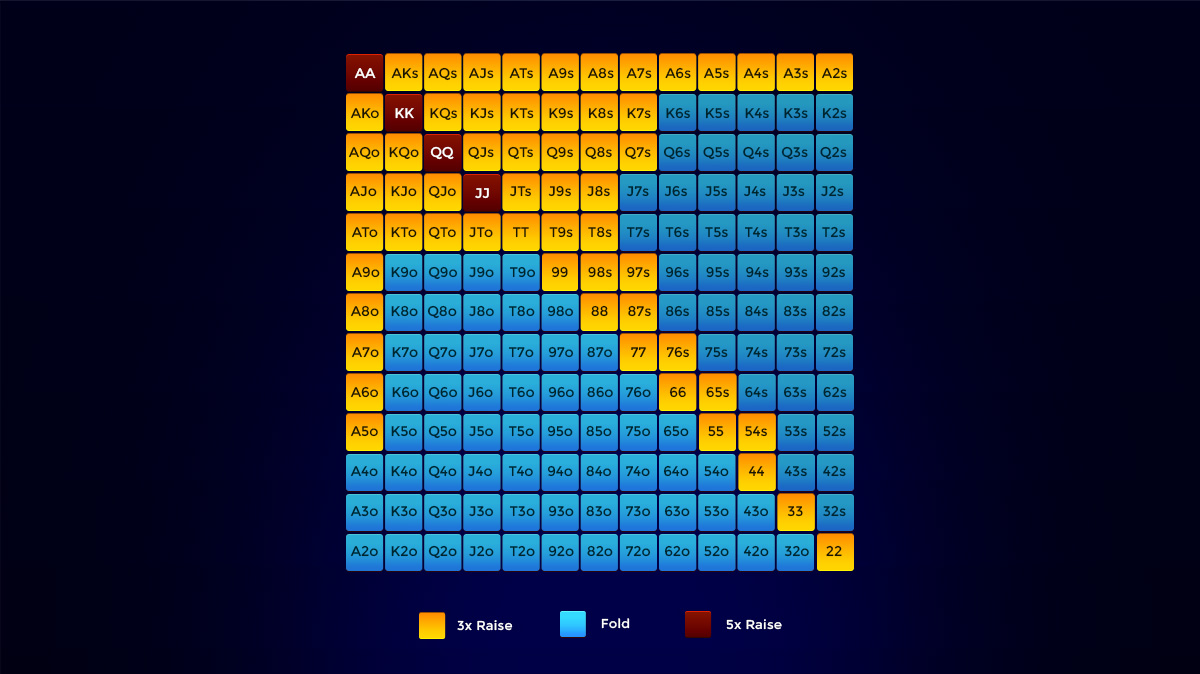
Example: A player who raises to 3bb with all hands except JJ, which they raise to 5bb, has made JJ trivially exploitable. Opponents fold to 5bb, continue against 3bb, and the player with JJ never gets action. Other forms of this leak include limping only with A-A from early position, or making pot-sized bets exclusively with flush draws.
How to exploit it: Pay close attention to sizing patterns early in a session. These tells can be identified quickly and exploited for the remainder of the game.
Why Is Raising for "Protection" a Mistake?
Definition: Raising for protection means making a large raise with a strong made hand specifically to price out drawing hands. The idea being that opponents shouldn't be allowed to outdraw you cheaply.
Rule: When opponents are drawing thin, you want them to stay in the pot. A large raise folds out exactly the hands you want to extract value from.
Example: You hold top pair on a dry board. Your opponent has a gutshot with roughly 16% equity. If you raise large and they fold, you've sacrificed all future value. If you bet a reasonable size and they call with a hand that misses 84% of the time, you profit consistently over the long run.
How to exploit it: Fold to large raises unless you hold strong equity against their range or a drawing hand with correct pot odds and implied odds. A straightforward player making an oversized raise is rarely bluffing.
When Do Players Overvalue Non-Premium Hands?
Definition: Overvaluing a non-premium hand means committing too many chips, typically by re-raising, with a holding like top pair when facing aggression that narrows the opponent's range to stronger holdings.
Rule: When a non-nut hand faces a raise, the default response is a call, not a re-raise. Re-raising folds out all bluffs and worse made hands, leaving only holdings that beat you.
Example: You raise AK, four players call, and the flop comes KQ7. You bet and face a raise. Re-raising folds out KJ and KT – hands you beat – while keeping KQ and 77 in the pot. Calling keeps the entire raising range active, including bluffs and dominated hands.
How to exploit it: Against players who cannot fold top pair, bet strong hands for value consistently and at a size that builds the pot. They will call more than they should.
Common Poker Mistakes at Medium Stakes
At medium stakes, players have enough baseline competence to survive, which means their leaks are smaller and harder to identify. The edge still exists, but requires more observation to find. Mistakes at this level are about frequency and calibration, not fundamental misunderstandings.
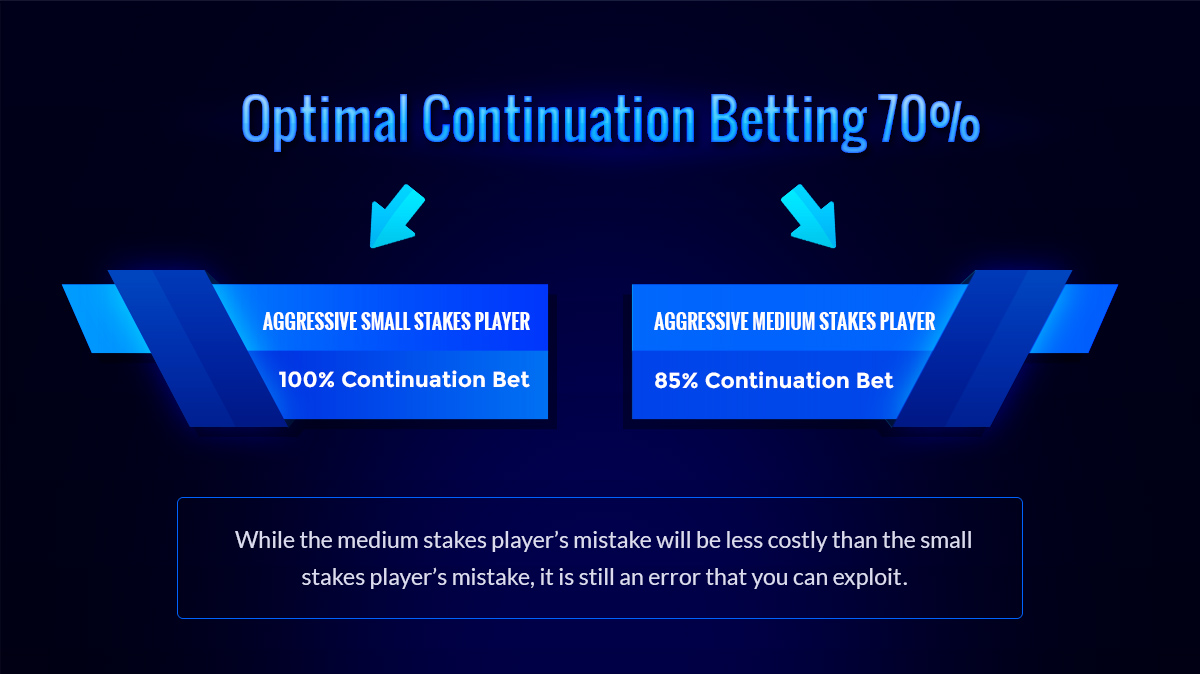
Example: If the optimal continuation betting frequency is 70%, a weak small stakes player bets 100% of the time. A weak medium stakes player bets 85%. Both are exploitable. The second requires more attention to detect, but the same principle applies: observe, identify the deviation, build a counter-strategy.
What Is Fancy Play Syndrome in Poker?
Definition: Fancy play syndrome (FPS) is the tendency to make unnecessarily complex plays like check-raises, multi-street bluffs and unconventional lines at a higher frequency than the situation warrants. It is usually driven by ego rather than strategy.
Rule: Winning at poker is primarily the result of opponents playing poorly, not of making spectacular plays. Deviating from fundamentally sound strategy without a clear, exploitative reason is a losing habit.
How to exploit it: Players with FPS are predictable in a different way. Their fancy plays tend to occur on a schedule or in specific spots. Once you identify the pattern, you can call down lighter or set traps accordingly.
How Often Should You Bluff in Poker?
Definition: Not bluffing enough means a player's betting range is too heavily weighted toward value, making it correct for observant opponents to fold almost every time they face aggression.
Rule: Bluffing must be incorporated at the right frequency and with the right hands. The correct bluff frequency depends on your bet size and street.
Preflop: Bluff with hands that can improve significantly (suited aces, suited connectors) or hands that block opponents from holding strong holdings. For example, holding an ace makes it less likely your opponent also holds one.
Flop and turn: Prioritize semi-bluffs. Hands with genuine equity if called, such as J♠️8♠️ or 9♣️8♣️ on 7♣️5♠️3♠️. These are unlikely to win at showdown on their own, but have meaningful draw equity on the next street.
River bluffing ratio: When making a pot-sized river bet, target roughly twice as many value combinations as bluffing combinations (2:1). As bet size decreases, reduce bluff frequency. As bet size increases, include slightly more bluffs. Value hands should always outnumber bluffs.
Bluff-raise selection: On the river, bluff-raise with hands too weak to call that also block the nuts. On a board of 9♣️8♠️6♠️4♦️3♣️, holding 77 blocks the straight and is a stronger bluff-raise candidate than K♠️Q♠️, which unblocks the flush draw and makes a made hand from your opponent more likely.
What Is Mindless Poker and Why Does It Lose?
Definition: Mindless poker means executing a strategy on autopilot – going through the motions without actively processing opponent tendencies, adjusting to table dynamics, or questioning individual decisions.
Rule: A solid strategy executed without attention is still a losing strategy. Poker requires active engagement, not just correct habits.
If you find yourself playing without genuine focus, from boredom, fatigue, or tilt, the correct decision is to stop. Mindless sessions compound every other leak on this list.
Common Poker Mistakes at a Glance
| Mistake | Stakes Level | Core Problem | How to Exploit It |
|---|---|---|---|
| Playing too straightforwardly | Small | Bet sizing reveals hand strength | Fold to aggression; bluff when they show weakness |
| Playing too trickily | Small | Deceptive patterns become readable | Treat abnormal actions as strong holdings |
| Telegraphing specific hands | Small | Unique sizing for one hand removes all ambiguity | Track sizing patterns early; adjust accordingly |
| Raising for protection | Small | Folds out thin draws you want to keep in | Fold to large raises; extract value from draws |
| Overvaluing non-premium hands | Small | Re-raises fold bluffs, keep only better hands | Bet for value repeatedly; they will overpay |
| Fancy play syndrome | Medium | Complex plays driven by ego, not edge | Call down lighter once you identify the pattern |
| Not bluffing enough | Medium | Value-heavy range is easy to play against | Fold to their bets with high confidence |
| Playing mindlessly | Medium | Autopilot amplifies every other leak | Apply pressure; they won't adjust |
Key Takeaways
- A poker leak is any repeatable mistake that costs money over time. Most players have several.
- If your bet sizing consistently reflects your hand strength, opponents can play perfectly against you.
- Predictable deception is as exploitable as straightforward play. Any consistent pattern becomes a tell.
- Never use a unique bet size for a single hand. It removes all range ambiguity for that holding.
- When opponents are drawing thin, the goal is to keep them in the pot, not price them out.
- Facing a raise with a non-nut hand, calling is almost always correct. Re-raising folds out the hands you beat.
- At medium stakes, leaks are about frequency and calibration. Observation matters more, not less.
- Fancy play syndrome costs money. Fundamentally sound play outperforms spectacular plays over the long run.
- At a pot-sized river bet, the correct bluff-to-value ratio is approximately 1:2 (one bluff for every two value hands).
- Mindless play amplifies every other leak. If you are not fully engaged, stop playing.
FAQ
What is a poker leak?
A poker leak is a repeatable mistake in a player's strategy that consistently costs money over time. Leaks can involve bet sizing, bluff frequency, hand selection, or decision-making under pressure. Most players at small and medium stakes have multiple leaks.
What is fancy play syndrome in poker?
Fancy play syndrome (FPS) is the habit of making unnecessarily complex plays more often than the situation justifies. It is typically driven by ego rather than strategic necessity and is a common leak among medium stakes players who have developed basic competence but overestimate the value of creativity over fundamentals.
How often should you bluff on the river?
The correct river bluffing frequency depends on your bet size. As a baseline, when making a pot-sized river bet, aim for roughly twice as many value combinations as bluffing combinations – a 2:1 ratio. As your bet size decreases, include fewer bluffs. As your bet size increases, you can add slightly more. Value hands should always outnumber bluffs.
What does playing too straightforwardly mean in poker?
Playing too straightforwardly means your bet sizing consistently and accurately reflects your hand strength: big bets with strong hands, small bets with medium hands, checks with weak hands. When opponents can read your hand strength from your actions alone, you become easy to play against and impossible to get value from.
Should you raise for protection in poker?
No. Raising large to "protect" a strong made hand is a mistake when your opponents are drawing thin. When a draw has low equity, you want it in the pot, not priced out. A standard-sized bet extracts value from draws that miss the majority of the time. A large raise folds out the weaker hands you want to continue and reduces your overall profitability.
