

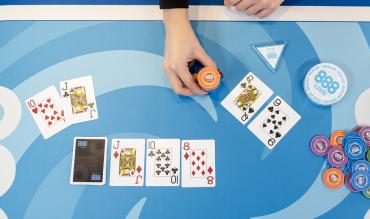

In poker, the nuts refers to the best possible hand at any given point in a hand. Flopping the nuts means your hole cards have combined with the flop to give you that unbeatable holding right now. It's one of the most powerful positions you can be in, but how you play it determines whether you walk away with a big pot or leave chips on the table.
Here are the key decisions and principles every player should understand when they flop the nuts.
- Bet for Value
- Slow Play for Value
- The Nuts Can Change
- Read Your Opponent's Hand
- Maximise Profit on Safe Runouts
- Protect Your Hand in Multiway Pots
- Know When to Fold
Bet for Value
The most straightforward play when you flop the nuts is to bet. On wet boards (those with flush or straight possibilities) betting serves two purposes: it builds the pot and it charges drawing hands to continue. A player with middle pair or top pair may call multiple streets, and that's exactly what you want.
Bet sizing matters here. Against a drawing-heavy board, a larger bet forces opponents to pay a meaningful price to chase their draws. Against a drier board, a smaller bet may keep weaker hands in the pot longer and extract more value overall. Consider your opponents' likely poker ranges before sizing up or down.
As a general rule: when in doubt, bet the best hand. Don't overthink it.
Slow Play for Value
On dry boards with little drawing potential, slow-playing is a legitimate alternative. The goal is to disguise the strength of your hand and give opponents the opportunity to bluff or build the pot themselves.
Example: you hold A♦️A♣️ and the flop comes A♠️8♥️2♣️. You've flopped top set on a board with no flush draw and no realistic straight draw. A large bet here is likely to fold out inferior hands immediately. Checking instead keeps opponents with weaker aces, pairs, or bluffs in the hand, and gives you the chance to check-raise on the flop or turn.
The key principle: balance your checking range by including strong hands alongside weak ones. If you only ever check with draws and marginal hands, your opponents will exploit that pattern quickly.
Slow-playing works best when: the board is dry, your opponents are aggressive, and your hand is so strong that it's unlikely to be outdrawn.
The Nuts Can Change
Flopping the nuts doesn't guarantee you'll still have the best hand on the turn or river. Boards change, and so does the nuts.
Example: you hold 7♣️7♦️ on a flop of 2♠️3♥️7♠️. You've flopped top set, currently the nuts. But a 4♠️ on the turn is a dangerous card. Suddenly, any player holding A-5 or 5-6 completes a straight, and the spade brings a flush draw into play simultaneously. Your hand goes from invulnerable to genuinely threatened in a single card.
Always account for how the turn and river can change the hand's dynamics. The best players think ahead: "What cards hurt me, and how do I respond if they land?"
Read Your Opponent's Hand
When you flop the nuts, the ideal scenario is that an opponent has also flopped a strong – but second-best – hand. That's where the biggest pots come from.
Example: you hold A♥️K♥️ and the flop comes K♣️K♠️A♦️. You've flopped a full house. Only pocket aces can beat you here, which is an unlikely holding given the board. A player with A-Q or A-J has flopped two pair and is likely to feel very good about their hand. A player who called pre-flop with K-Q or K-J has flopped trips and may be willing to put in significant chips.
In spots like this, checking can be powerful. Let your opponent build the pot for you. The player with trips or two pair doesn't know where they stand – and that uncertainty is profitable for you.
Use hand reading to identify which opponents might have connected with the board, and adjust your line to extract maximum value from the most likely holdings.
Maximise Profit on Safe Runouts
When the board is relatively safe and you're confident in your lead, the priority is extracting as many chips as possible across all three streets.
"Feeler" bets on the flop (a sizing that's not threatening but still builds the pot) can help establish your opponent's range. A calling station who holds top pair or a weak draw will often call on the flop, turn, and river, particularly if they suspect you're semi-bluffing or continuation betting with air.
Don't be put off by an opponent's raise or re-raise. Unless the board has dramatically changed and their line makes sense for a hand that beats you, continue building the pot. A strong understanding of bet sizing is essential here – you want to charge opponents as much as they'll call, not so much that they fold.
Protect Your Hand in Multiway Pots
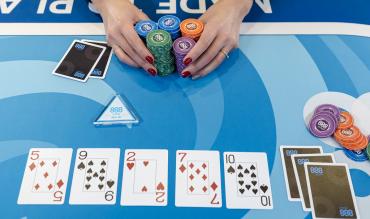
In multiway pots, flopping the nuts creates a different problem: more players means more drawing hands, and more chances for one of them to get there.
Example: you hold 7♦️7♠️ on a flop of 7♣️2♠️3♥️. You've flopped top set. In a heads-up pot, you have room to slow-play. In a four-way pot, hands like 4♣️5♣️, A♣️4♣️, or any suited connector have legitimate drawing equity against you. Letting them in cheaply is a mistake.
In multiway spots, bet to thin the field. Eliminate the hands that can outdraw you before they get the chance. Slow-playing or betting small not only allows drawing hands to continue – it can also invite runner-runner scenarios that cost you a pot you should have won comfortably.
This is especially true in tournament play, where preserving your stack matters as much as winning pots.
Know When to Fold
Even the nuts can become a losing hand. Strong players know when the board has shifted enough that their originally dominant holding is now behind – and they're able to fold without hesitation.
Example: you hold J♠️9♠️ on a flop of 8♥️10♦️Q♦️ – the nut straight. A turn of K♦️ is a red flag: three diamonds are now on board, and a player with A♦️ has a flush draw plus the best straight draw. A fourth diamond on the river, combined with aggressive action from your opponent, is a strong signal that your straight has been beaten.
Calling off chips in this spot because you "started with the nuts" is a common and costly mistake. The hand you had on the flop is not the hand you have on the river. Read the action, consider your opponent's range, and fold when the evidence points clearly against you.
The ability to release a big hand is one of the clearest markers of an experienced player.
Key Takeaways
- Flopping the nuts means holding the best possible hand at that moment – not necessarily by the river.
- Bet for value on wet boards; slow-play on dry boards where opponents are unlikely to fold to aggression.
- Balance your checking range by mixing in strong hands, not just draws and weak holdings.
- Always consider how the turn and river can change the best possible hand – and yours with it.
- In multiway pots, protect your hand with larger bets to eliminate drawing hands before they can get there.
- Use hand reading to identify opponents who have also connected with the board – those are your biggest value targets.
- Be willing to fold a strong hand when the board and your opponent's action indicate you're now behind.
