



ICM, short for the Independent Chip Model, is the maths that converts a tournament chip stack into its share of the prize pool. It works from three inputs: every remaining player's stack, the number of players still in, and the payout structure. The figure it returns is what your chips are actually worth in money.
That figure matters because tournament chips behave nothing like cash game chips. Double your stack in a cash game and you double your money. Double it in a tournament and you don't come close, which is why so many correct-looking calls at a final table turn out to be quietly disastrous.
This guide covers what ICM measures, what it ignores, how to calculate it by hand, and how ICM pressure should change the way you play the bubble and the closing stages.
What Does ICM Mean in Poker?
ICM stands for Independent Chip Model. It tells a poker player, at any stage of a poker tournament, what their current tournament equity is: how much of the prize pool would be theirs if the tournament stopped right now.
The model has two practical uses:
- In-hand decisions. Knowing what your stack is worth tells you whether a call that wins chips actually wins money, which is the only question that counts in tournament poker.
- Chops. When players agree to split a prize pool before the end, ICM is the standard method for working out who gets what. See our guide to the poker chop for how those negotiations work in practice.
The reason ICM exists is that the value of a tournament chip shifts every time a player busts or a pay jump arrives. In a cash game, a chip is worth its face value from the first hand to the last.
ICM Chart: What ICM Considers and What It Ignores
ICM is a narrow model. It takes four inputs and nothing else, which explains both its usefulness and its blind spots.
What ICM Considers
- The size of each remaining player's chip stack
- The total number of chips in play
- How many players are still in the tournament
- The payouts still to be awarded
What ICM Ignores
- Blind levels, antes, and how deep the stacks are in big blinds
- The speed of the structure and the length of levels
- Player skill, at your table or anywhere else
- Table position, and who is about to post the big blind
A 15bb stack and a 40bb stack of identical chip counts are the same stack to ICM. That's a real limitation, and it's covered later in this guide.
How Does ICM Work in Poker?
Take a 10-player SNG paying 50% for first, 30% for second and 20% for third. Everyone starts with 1,000 chips, so there are 10,000 chips in play and every player begins with exactly 10% of the prize pool as their EV.
On the first hand, Player 1 doubles up and Player 10 busts. Player 1 now holds 2,000 chips, which is 20% of the chips in play. Has his tournament equity doubled from 10% to 20%?
It hasn't. Run the numbers and Player 1's equity comes out at 18.44%.
The shortfall exists because the prize pool is split three ways. In a winner-takes-all event, holding 20% of the chips would give a 20% shot at 100% of the money, and equity would be exactly 20%. Here, the most anyone can win is 50% of the pool, so extra chips buy progressively less.
The missing equity didn't vanish. The eight players who folded every hand each gained roughly 0.19%, moving from 10% to about 10.19%. They now have the same chips as before with one fewer opponent to beat.
Payout structure changes the answer too. Run the identical scenario with payouts of 65%, 25% and 10%, and Player 1's equity lands at 19% instead of 18.44%. The flatter the payouts, the less a big stack is worth.

How to Calculate ICM in Poker
Manual ICM calculations get long quickly, but working through two of them is the fastest way to understand what the model is doing.
The Simplest Case: Two Players Left
Two players remain in a 6-player SNG that started everyone with 1,000 chips. First pays 70%, second pays 30%. Player 1 has 5,900 chips, Player 2 has 100.
Both players are already guaranteed 30% of the pool, because second place is the worst either can finish. That locks up 60% of the prize money, leaving 40% genuinely up for grabs, which is the gap between first and second.
So Player 2's equity is his guaranteed 30% plus his share of that contested 40%:
30% + ((100 / 6,000) × 40%)
= 0.3 + (0.0167 × 0.4)
= 0.3 + 0.0067
= 30.67% tournament equity
Now double Player 2's stack to 200 chips. His equity moves to 31.33%. He doubled his chips and gained two-thirds of one percent.
Three Players Left: The 2019 WSOP Main Event
With three or more players, you have to work out the probability of each finishing position separately. Here are the chip counts at the start of Day 9 of the 2019 WSOP Main Event, three-handed:
- Hossein Ensan - 326,800,000 (63.5% of chips in play)
- Alex Livingston - 120,400,000 (23.4%)
- Dario Sammartino - 67,600,000 (13.1%)
Total chips in play: 514,800,000. No chop took place, but the calculation shows the method.
Probability Ensan finishes first: his chip share, 63.5%.
Probability Ensan finishes second: calculate each route separately. If Livingston wins (23.4%), Ensan then beats Sammartino 326.8 / (326.8 + 67.6) = 82.9% of the time, giving 0.234 × 0.829 = 19.4%. If Sammartino wins (13.1%), Ensan beats Livingston 326.8 / 447.2 = 73.1% of the time, giving 9.6%. Added together, 29%.
Probability Ensan finishes third: the remainder, 7.5%. You can reach it the long way (4% plus 3.5% across the two routes) or by subtracting 63.5% and 29% from 100%.

Now convert those percentages into money. The top three payouts were $10,000,000, $6,000,000 and $4,000,000:
- First: 0.635 × $10,000,000 = $6,350,000
- Second: 0.290 × $6,000,000 = $1,740,000
- Third: 0.075 × $4,000,000 = $300,000
Ensan's total tournament EV heading into Day 9 was $8,390,000. Had the three players chopped by ICM at that moment, that's the figure he'd have taken.
Expressed as a percentage, divide $8,390,000 by the $20,000,000 still to be awarded. Ensan's equity was 41.95%, well below his 63.5% chip share.
The ICM Formula, Step by Step
- Note every remaining player's chip stack.
- Divide each stack by the total chips in play. That gives each player's probability of winning.
- Work out every possible finishing order, then calculate the likelihood of each. Start with the winner's chip share, then multiply by the next player's chips divided by the chips remaining among players not yet placed.
- Multiply each finishing probability by the prize for that position, add the results together, and divide by the total prize money still to be awarded.
With four or more players the number of finishing orders explodes, which is why almost nobody does this by hand.
ICM in Satellites: The Most Extreme Example
Satellites push ICM to its limit, because every paid finisher wins the same prize. Six players remain and the top five each win a $25 ticket:
- Player 1 - 5,000 chips, worth $24.892
- Player 2 - 3,000 chips, worth $24.538
- Player 3 - 1,800 chips, worth $23.493
- Player 4 - 1,000 chips, worth $20.608
- Player 5 - 700 chips, worth $17.623
- Player 6 - 500 chips, worth $13.846
The chip leader holds ten times the short stack's chips and his stack is worth less than double. Player 6 could double up and still gain only a few dollars of equity.
The consequence is stark. In a satellite, a big stack can correctly fold pocket Aces facing an all-in from a player who has him covered, because winning adds almost nothing to a ticket he's already close to securing, while losing costs the ticket entirely.
What Is ICM Pressure?
ICM pressure is the set of adjustments players have to make to their ranges because of what a bust-out would cost them in money. It's the practical expression of everything above.
Take three players in the money with stacks of 9,000, 6,000 and 3,000.
- The medium stack is the most constrained. Losing a big pot to the big stack costs real equity and can leave him on the ropes. He'd prefer the short stack to bust first, which lifts his equity for free. He can take measured risks against the short stack, with caution.
- The big stack can apply pressure to everyone, and to the medium stack most of all, since that player is handcuffed between the two. Even doubling up the short stack leaves the chip leader in good shape.
- The short stack has the freest hand and should look for double-ups. If he can choose an opponent, the medium stack is the target, since knocking that player down does more for his equity than doubling through the big stack.
The size of these edges can look trivial. With stacks of 9,000, 6,000 and 3,000, the middle stack holds 34% equity against the 33.3% he'd hold if all three were level. Two-thirds of a percent, repeated across a year of tournaments, is a meaningful part of a win rate.
The same relative stack logic applies across a full final table in an MTT, where every elimination brings a pay jump, and it applies hardest of all on the bubble.
How ICM Changes Play on the Bubble
The bubble is the one point where equity swings between everything and nothing. Bust before it and you leave with no return on your buy-in. Get past it and you have a minimum payout locked up. Short stacks tighten up, and good big stacks attack them for it.
Here's what that looks like as a calculation. Four players remain on the bubble of a 9-player SNG, all with 4,500 chips. Blinds are 200/400 with a 25 ante. The cutoff folds, the button shoves, the small blind folds, and you look down at QJs in the big blind.
First, assume the button's shoving range, roughly 42.87% of hands:
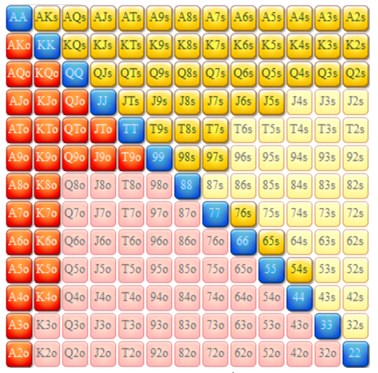
22+, A2+, K2s+, K4o+, Q2s+, Q9o+, J5s+, J9o+, T7s+, T9o, 97s+, 76s, 65s, 54s
Against that range, QJs wins 47.69%, ties 3.10% and loses 49.21%. You have 4,075 chips behind and the pot holds 5,175, so you're calling 4,075 to win 5,175.
By pot odds alone you need 44.05% equity, and counting ties you have 49.24%. In a cash game this is a comfortable call.
Now price it in tournament equity instead of chips. Multiply each outcome by the equity you'd hold afterwards:
- Win: 47.69% × 38.72% = 18.47%
- Tie: 3.10% × 25.45% = 0.79%
- Lose: 49.21% × 0% = 0%
Calling is worth roughly 19.25% of the prize pool. Folding leaves you with 4,075 chips against 4,275, 5,175 and 4,475, which an ICM calculator prices at 23.47%.
Calling costs you 4.22% of the prize pool on average. The clear cash game call is an easy muck here.
Scale that up and the number stops looking small. With around $23 million spread across the last four spots at a WSOP Main Event, 4.22% of equity is roughly $970,600 gone on a single call.
An ICM Disaster: Cheong Against Duhamel
The 2010 WSOP Main Event final table produced the most-discussed ICM spot in poker history. Three players left:
- Joseph Cheong - 95,050,000 (43%)
- Jonathan Duhamel - 88,100,000 (40%)
- John Racener - 36,450,000 (17%)
Racener folded the button. Cheong raised to 2.9 million from the small blind with A♠7♥. Duhamel 3bet to 6.75 million with Q♣Q♦. Cheong 4bet to 14.25 million. Duhamel 5bet to 22.75 million. Cheong 6-bet jammed for 95.05 million, covering Duhamel.
The case for the jam had two parts. Holding an Ace cuts Duhamel's AK and AQ combinations from 16 to 12 and halves his Pocket Aces combinations from 6 to 3. And Cheong had Duhamel covered, so a call would put Duhamel's entire tournament on the line while Racener sat with 17% and no risk at all.
The case against it is the hand selection. Suited or connected AX combinations make far better 6-bet shove candidates than A7 offsuit, and settling the question properly means working through hand ranges, hand equities and tournament equities together.
Duhamel called. The Queens held. Duhamel went to 176 million against Racener's 36 million and Cheong's 7 million, Cheong busted in third shortly afterwards, and Duhamel won the bracelet.

When Does ICM Not Apply?
ICM pressure isn't constant. It concentrates in two places: the bubble, where the jump from nothing to a min-cash is the largest multiplier in the tournament, and the final table, where the gaps between payouts are widest.
Everywhere else it's technically present and practically minimal, and those stages play closer to a cash game.
ICM also disappears entirely in winner-takes-all formats. With one prize, chip EV and money EV are identical, and the maths works exactly as it does in a ring game. The closer a structure gets to a satellite, where every paid place wins the same amount, the more severe the ICM implications become.
ICM Calculators and Software
Calculating three-handed ICM for one player takes several minutes by hand. Four-handed or five-handed, the number of finishing orders makes it impractical, which is why calculators exist.
Some tracking software now includes a basic ICM calculator. Free web tools such as ICMizer handle up to 15 players and payouts, and mobile apps cover the same ground away from a desk.

Push/fold trainers like SnapShove let you set player counts, position, effective stacks, blinds and antes, and they're the quickest way to build instincts for short-stacked spots. Tools that fold ICM and payout structure into those push/fold calculations take it a step further.
The point of running these calculations is to do them away from the table. You won't be computing equity mid-hand. You'll be recognising a spot you've already studied.
The Limits of ICM
ICM gives you a baseline, and it's worth knowing what that baseline leaves out.
It assigns no value to skill, so it treats a recreational player and a seasoned professional with equal stacks as equally likely to win. It ignores position, blind pressure and who posts next, so a stack that's about to be swallowed by the blinds looks identical to one that isn't. And it assumes every remaining player will play the rest of the tournament identically, which no final table has ever done.
Use it as the floor under your decision, then adjust for what you know about the table.
Key Takeaways
- ICM converts your chip stack into its share of the prize pool, using remaining stacks, remaining players and remaining payouts.
- Doubling your chips never doubles your equity in a tournament with more than one paid place.
- Every player who busts hands equity to everyone still seated, whether or not they played the hand.
- Flatter payout structures reduce the value of a big stack. Satellites are the extreme case.
- ICM pressure concentrates on the bubble and at the final table, and is minimal elsewhere.
- Medium stacks are the most constrained, big stacks have the most leverage, short stacks have the most freedom.
- A call that's clearly correct on pot odds can still be a significant equity loss once ICM is applied.
- Winner-takes-all formats carry no ICM pressure at all.
- ICM ignores skill, position and blind depth, so treat it as a baseline and adjust from there.
