

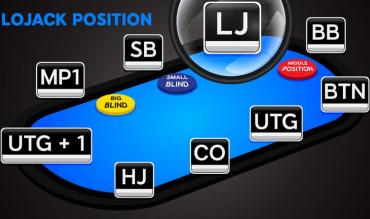

The lojack (LJ) is the earliest position in 6-max games and one of the most challenging seats at the poker table. Players act before the hijack, cutoff, and button, which severely limits profitable opportunities. The strategic outlook from the LJ is simple: play tight, wait for premium holdings, and avoid getting out of line.
What Is the Lojack Position?
The lojack is the earliest position in short-handed (6-max) games. In full-ring games, it is the third position after the two blinds and UTG.
Key constraints of the LJ seat:
- Three players act after you preflop (HJ, CO, BTN), plus the blinds.
- Cold calls are easily squeezed or overcalled by later positions.
- 3bets can face a cold 4bet from the HJ, CO, BTN, SB, or BB.
- You will almost always be out of position postflop.
- In full-ring, you face very strong opening ranges from earlier positions.
LJ Preflop Strategy: Key Frequencies
Good players target the following frequencies from the lojack in a standard NLHE cash game. These figures account for a range of different open-raise sizings.
- Raise-first-in (RFI): ~13%
- Cold call frequency: ~4%
- 3bet frequency: ~4%
These numbers reflect how little room there is to manoeuvre from this seat. The LJ is not a position designed to generate large profits, it's a position designed to avoid large losses.
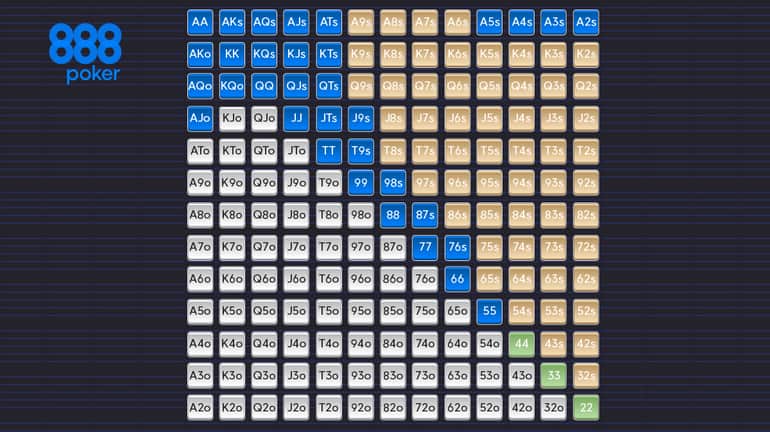
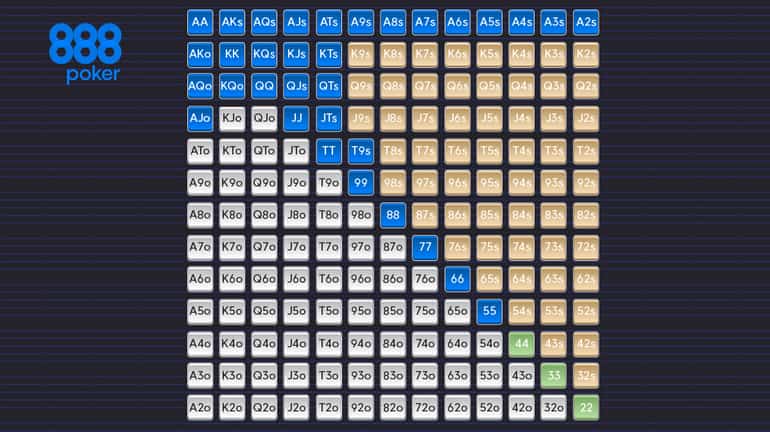
LJ Raise-First-In Range (~13%)
"Raise-first-in" means open-raising preflop after all players before you have folded. From the LJ, this is the most profitable scenario, and the only open-raise scenario in 6-max.
The 13% RFI range reflects the balance between stealing the blinds and avoiding exploitation by strong players acting behind. Expanding much beyond 13% gives observant opponents an opportunity to 3bet profitably against a wide range.
Against weaker players or habitual folders in later positions, a modest expansion up to ~18% can be justified. Wider than that is rarely correct.
- Blue: Open raise 100% of the time
- Beige/Tan: Open raise at a mixed frequency
- Green: Open raise at a low frequency
LJ Defence vs Early Position Open
When facing an open raise from an early position in full-ring, the LJ defending range is tight. Both cold calling and 3betting are constrained by the number of players still to act behind.
- Purple: 3bet (re-raise) range
- Blue: Cold call range
The 3bet range is weighted heavily towards high-equity holdings. 3bet bluffing speculative hands is not recommended in most player pools, as the average opponent does not fold enough to 3bets to make it profitable. Defending range widens slightly against later-position openers, but remains tight regardless.
LJ vs 3bet: How to Respond
After open-raising from the LJ, expect to face 3bets regularly. The correct response depends on where the 3bet originates.
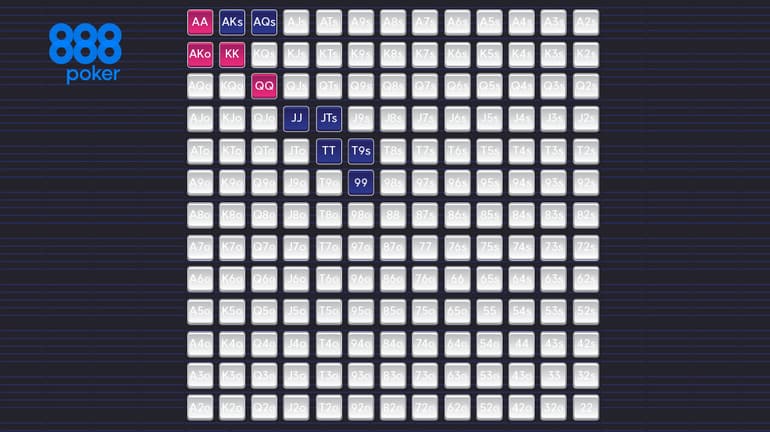
vs Blinds 3bet
When the 3bet comes from the SB or BB, there is slightly more room to continue. 4bet bluffing is generally not incentivised, so focus 4bets on high-equity value hands only.
- Blue: Call vs 3bet
- Purple: 4bet (re-raise) vs 3bet
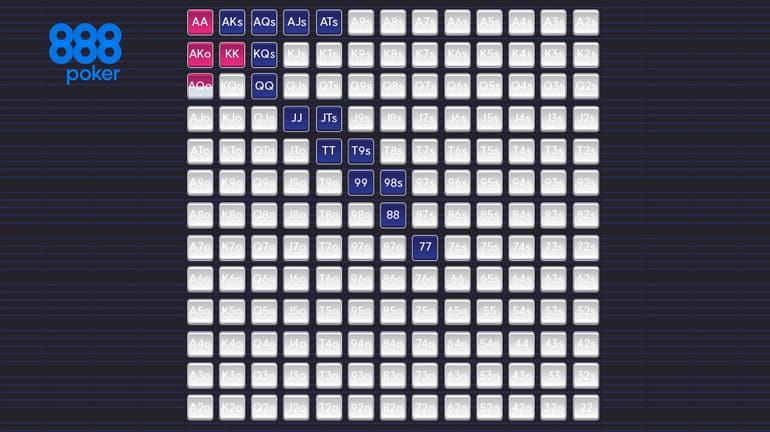
vs BTN/CO 3bet
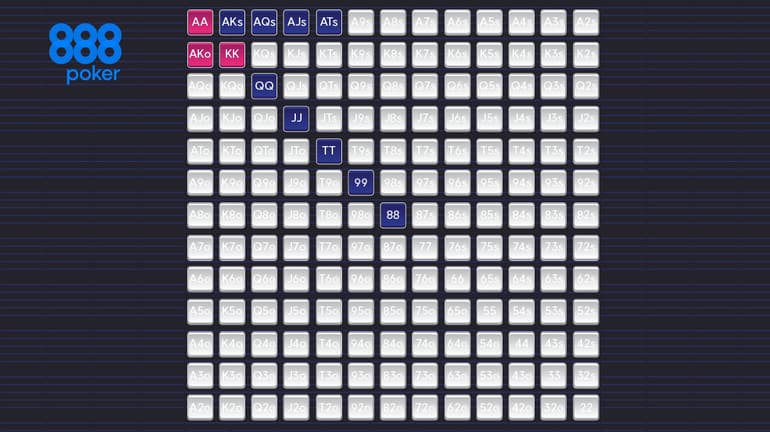
A 3bet from a late-position player represents a stronger range than from the blinds. Respond with a tighter continuing range. The same principle applies: 4bet for value only, not as a bluff.
- Blue: Call vs 3bet
- Purple: 4bet (re-raise) vs 3bet
Full-Ring Only Scenarios
The following two situations only arise in full-ring games, where earlier positions exist and limpers are possible.
Iso-Raising
An iso-raise in poker is a preflop raise made against a limper. From the LJ in full-ring, the iso-raising range is similar to the RFI range but weighted further towards high-equity hands, given the additional players still to act.
See colour key above.
Overcalling and Squeezing
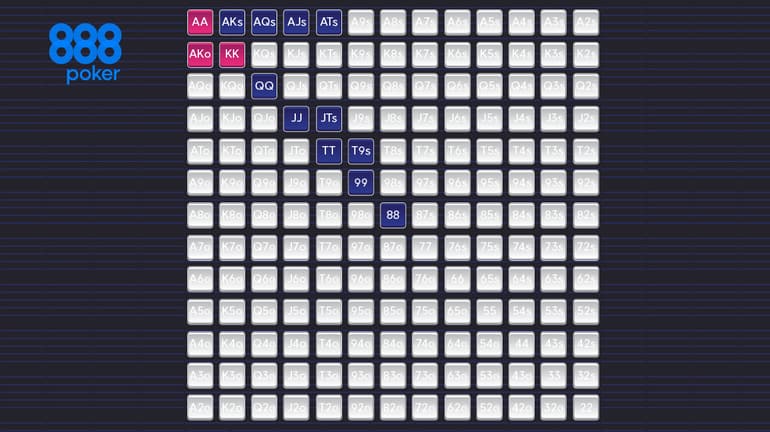
An overcall is a call after another player has already called. A squeeze is a 3bet made after at least one caller has already acted vs an open raise. From the LJ in these multiway spots, weight squeezes towards strong high-equity holdings and overcalls towards suited/connected speculative hands.
- Purple: Squeeze range
- Blue: Overcall range
Key Adjustments
Sample ranges are a starting point. Adjust based on the following variables:
- Villain's sizing: Larger open or 3bet sizing → defend tighter.
- Opener's position: Later position opener → defend slightly wider.
- Reads: If Villain folds too much to 3bets or 4bets, increase aggression accordingly.
- Villain skill level: Weaker players justify playing more hands, but expansion from the LJ remains limited regardless.
- Players behind: If later positions fold too often or play poorly, modest RFI expansion is warranted.
Key Takeaways
- The lojack is the most constrained early position in 6-max – play tight and patient.
- Target ~13% RFI, ~4% cold call, and ~4% 3bet as baseline frequencies.
- 3bet and 4bet ranges should be heavily value-weighted. Bluffing is rarely incentivised from this seat.
- Cold calls are vulnerable to squeezes and overcalls from multiple positions behind.
- Iso-raising and squeeze/overcall scenarios only apply in full-ring games.
- Adjust all ranges based on sizing, reads, and the quality of players acting behind you.
FAQ
What is the lojack position in poker?
The lojack (LJ) is the earliest position in 6-max games and the third position in full-ring games, acting after the two blinds and UTG. It is one of the most positionally challenged seats at the table.
What hands should I open from the lojack?
A standard lojack open-raising range covers around 13% of holdings. This includes strong broadways, pocket pairs down to 66, and suited connectors with high equity. Expanding beyond ~18% is rarely correct.
How often should I 3bet from the lojack?
Around 4% is the recommended baseline. 3bets from the LJ should be heavily value-weighted – bluffing speculative hands is not incentivised because players behind can cold 4bet, and most opponents do not fold enough to 3bets to make bluffs profitable.
When should I cold call from the lojack?
Cold calling from the LJ should be limited to around 4% of hands. Cold calls are vulnerable to squeezes and overcalls from the hijack, cutoff, button, and blinds. Only hands with strong equity or good multiway potential justify calling.
